
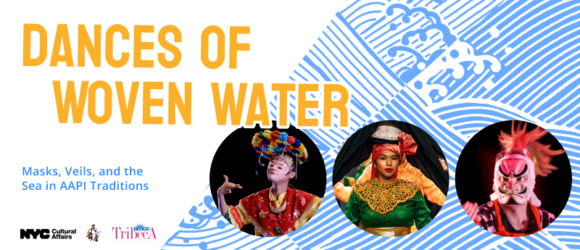
Dances of Woven Water
- At April 01, 2026
- By JFDNY
- In Uncategorized
 0
0
Dances of Woven Water
Masks, Veils and the Sea in AAPI Traditions
Presented by The Japanese Folk Dance Institute of NY
“Dances of Woven Water” draws from traditional Asian and Pacific folk dances from Japan, Indonesia, Korea, and Hawaii. Once performed by sailors, these ancestral dances honor the beauty and immense power of the sea. Through veiled forms, masked figures and flowing movement, the work brings the past into the present, uniting all in a living tapestry of dance.
PERFORMERS:
Minbuza (Japan) @
Saung Budaya (Indonesia) @saungbudaya
Hālau Hula O Nā Mele ‘Āina O Hawai‘i (Hawaii) @hulanewyork
Sutra Dance (Korea)
Location
BMCC Tribeca PAC
199 Chambers St. NY, NY
Date/Time
7PM Saturday, June 20
2PM Sunday, June 21
( Show runs for approximately 90 Minutes )
Tickets
$25 for adults
$15 for students, children, and seniors
Purchase Tickets Here!
About the Artists

MINBUZA (THE JAPANESE FOLK DANCE INSTITUTE OF NY)
The Japanese Folk Dance Institute of NY (JFDINY) was formed by Momo Suzuki (Director) in 1992. Minbuza is the professional performing arm of JFDINY.
Minbuza has performed at various schools, theaters, and other venues throughout the five boroughs and beyond. Some of our proudest achievements include performing at the Epcot Pavilion at Disney World in Florida, the Macy’s Thanksgiving Day Parade, annually at the Brooklyn Botanic Garden’s Cherry Blossom Festival, as well as an appearance in Madonna’s music video “Nothing Really Matters”. In 2023, we were thrilled to present The Festival Of Japan: Drums + Dance, a collaborative performance between Minbuza and the world-renowned traditional drummers of Sukeroku Taiko from Japan to celebrate our 30th Anniversary.
Recent national media appearances include NBC’s Today Show (2021) and dance film “Dancing Joy” (2020). Minbuza’s annual performance schedule includes over 30 performances.
SAUNG BUDAYA
Saung Budaya Dance was established in 2006 when dance instructor Amalia Suryani came to New York City and held dance workshops in the Indonesian Consulate. Our goal is to introduce the diverse Indonesian culture through dance and music to the Indonesian-American youths in New York City and, more generally, to the wider public.
Throughout the years, Saung Budaya has grown to become a vital part of the Indonesian community culture in New York. A variety of dances from all over the Indonesian Archipelago are taught within the group, who have performed around in the East Coast / Tri-State Area. Saung Budaya currently consists of 20 dancers whom are mostly students and young professionals.
HĀLAU HULA O NĀ MELE ‘ĀINA O HAWAI‘I
Hālau Hula O Nā Mele ‘Āina O Hawai‘i is an NYC based hula school.
The hālau, or hula school, first opened its doors in New York City in May 1968 under the guidance of Luana Haraguchi. Classes were first held in Haraguchi’s Upper East Side studio apartment. The hālau was given its name from her teacher, Iolani Luahine. The name translates to “Dance School of the Songs of the Land of Hawaii.”
From its small roots flourished a group that comprised of dedicated students learning hula and Hawaiian traditions.
Past performances include the World International Hula Festival in Honolulu, HI, New York Botanical Garden in NYC, and internationally at the Serpentine Sackler Gallery in London, England and The MAXXI Museo nazionale delle arti del XXI secolo in Rome, Italy.
SUTRA DANCE
Myung S. Lee is a founder and director of SUTRA DANCE company, whose vision is to share Korean Buddhist dance with others. An accomplished Buddhist researcher of Bumpae culture (Korean Buddhist chanting, dance, and music), she has students for the first time in Bumpae history in North America and Europe.
Touring extensively since 1984, Ms. Lee participated in the national Youngsanjae performance in Seoul, Korea with human cultural assets as well as a performance tour in 18 U.S. cities with her master Ven. Donghee Han, who was a Korean Intangible Cultural Treasure. She also opened Bumpae classes and workshops for the ‘INBI World’ four times in Moscow, Russia, and she was the first Buddhist artist to introduce and demonstrate Bumpae art in Russia.
When she came back to the United States, she continued to share Bumpae with North American audiences. She began to study and reorganize the traditional Bumpae into modern style, which was performed in temples, institutions and theatres. She has been very active teaching Bumpae at local art institutions in New York since 2001, and performing Buddhist sutra dance full of vitality. She was awarded a certificate from Ven. Guhae Sunim, who is the only title bearer of Korean Intangible Cultural Treasure, for contribution to instructing Bumpae over 40 years in U.S. and Russia. She has been producing, directing and choreographing over 30 traditional Buddhist productions in performance venues nationwide and internationally in South Korea and Russia.
This program is supported, in part, by public funds from the New York City Department of Cultural Affairs in Partnership with the City Council.



You must be logged in to post a comment.